
T-Mobile × UScellular Acquisition
OVERVIEW
This project supported T-Mobile’s acquisition of UScellular through a year-long, multi-phase digital integration. The work focused on maintaining seamless customer experiences at Deal Close while designing and delivering the transition from UScellular to T-Mobile digital products. A core challenge was executing production-ready designs across two design systems while laying the foundation for long-term brand migration.
-
Lead UI Designer
Defined and executed UI strategy by balancing user needs, business goals, and technical constraints
Partnered closely with product, engineering, and stakeholders to align on priorities and move work forward
Designed end-to-end web and mobile experiences, from wireframes to high-fidelity UI and interactive prototypes
Worked across and extended design systems to create consistent, scalable UI patterns
Supported development through clear handoff, reviews, and ongoing design collaboration
-
Figma
-
Engagement Partner
Engagement Director
Lead UX Designer
Lead UI Designer
UI Designer
-
12 months (3 phases)
THE PROBLEM
After acquiring UScellular, T-Mobile needed to merge two complex digital ecosystems without disrupting customers or frontline employees. Each company operated with different systems, plans, and tools across consumer, business, and prepaid services, creating a fragmented experience.
Frontline teams were forced to navigate disconnected systems and inconsistent data, slowing their ability to support customers during a high-stakes transition. Customers felt this friction through confusing experiences, limited self-service, and mismatches between what they could do and what employees could see.
As the brand migration approached, the risk increased. T-Mobile needed a clear plan to unify systems, workflows, and experiences across launch day, the first 100 days, and beyond.
Without a unified digital foundation, operational efficiency, customer trust, and brand integrity were all at risk.
THE SOLUTION
Working closely with designers, engineers, project managers, and business stakeholders from both UScellular and T-Mobile, we designed and delivered end to end customer journeys that guided customers through a smooth transition across web and app experiences.
We mapped the full customer lifecycle, identified friction points, and translated complex migration requirements into clear, high fidelity designs. Our team worked across both UScellular and T-Mobile design systems, creating production ready experiences in each brand while maintaining consistency, usability, and accessibility.
By designing in parallel across two brands and platforms, we created intuitive, scalable journeys that supported customers before, during, and after migration.
The result was a cohesive digital experience that reduced confusion, increased self service adoption, and established a strong foundation for a unified T-Mobile ecosystem.
RESEARCH
Conducted research and discovery to inform the design approach, leveraging both existing resources and active collaboration with T-Mobile and UScellular design teams. Key activities included:
Reviewed UScellular brand guidelines, Figma design system components, icon and font libraries
Analyzed personas, journey maps, current state pain points, and critical use cases
Examined supporting documentation including interview notes, usage data, and screenshots of customer and employee experiences
Studied competitive examples and back-end system requirements to ensure technical feasibility
Held several meetings with both design teams to align on goals, scope, and constraints
Established weekly and daily touchpoints to maintain continuous collaboration and feedback
This approach ensured that design decisions were grounded in user needs, technical realities, and consistent cross-team alignment.
DESIGN APPROACH
The design work focused on guiding customers through a complex, multi-phase transition while keeping experiences clear, familiar, and reliable at every step. We accounted for multiple user states, including existing customers, new prospects, authenticated users, and customers eligible for migration.
Across all phases, the goal was to reduce confusion, build trust, and progressively move customers toward a fully unified T-Mobile experience without disrupting service or daily account management.
The following phases outline how the design evolved over time, from initial merger messaging to full system and brand consolidation.
Phase 1: Deal Close
Introducing customers to the acquisition with calm, contextual messaging
Phase 1 focused on introducing the acquisition to UScellular customers at Deal Close while preserving stability and trust.
This marked customers’ first exposure to the merger, so the objective was to communicate change clearly and calmly without disrupting existing account experiences.
We embedded lightweight, contextual messaging within familiar UScellular and T-Mobile digital environments, ensuring customers understood what was changing, what remained the same, and what to expect next. The experience was intentionally non-intrusive, reinforcing service continuity while setting the foundation for future integration phases.
Key deliverables included:
Co-branded web and mobile banners embedded within authenticated account experiences
FAQ banner concepts and supporting FAQ page designs across both brands
Dedicated informational web pages explaining the acquisition in clear, customer-centered language
Conceptual UScellular designs aligned to existing USCC patterns
Production-ready T-Mobile designs deployed across T-Mobile digital properties
By maintaining clarity and consistency across brands, Phase 1 established early customer confidence at Deal Close and created a stable foundation for the transition work that followed.
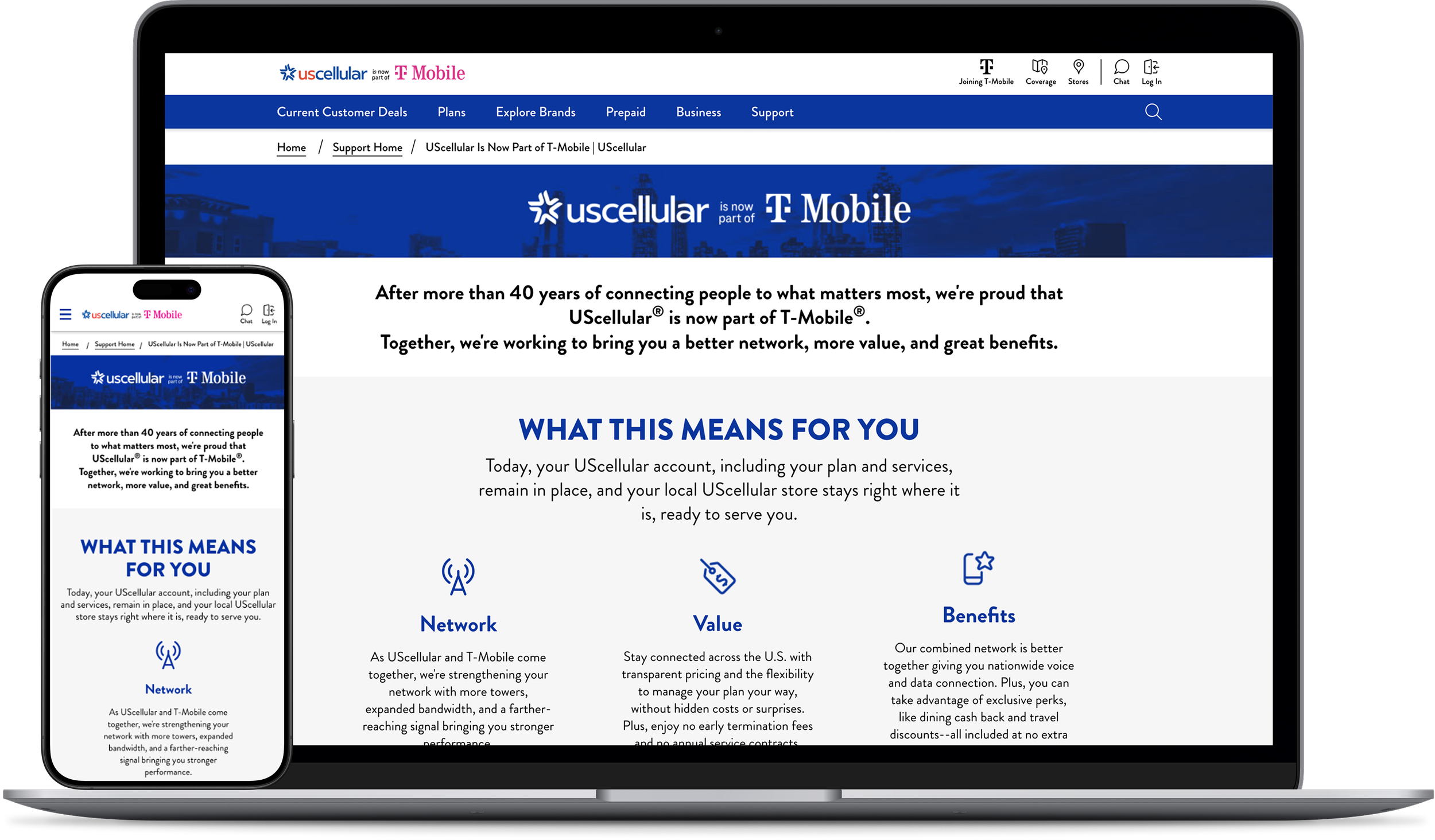
Phase 1 Deal Close web experience, marking the first on-site co-branded UScellular and T-Mobile messaging customers saw after receiving prior communications about the acquisition.
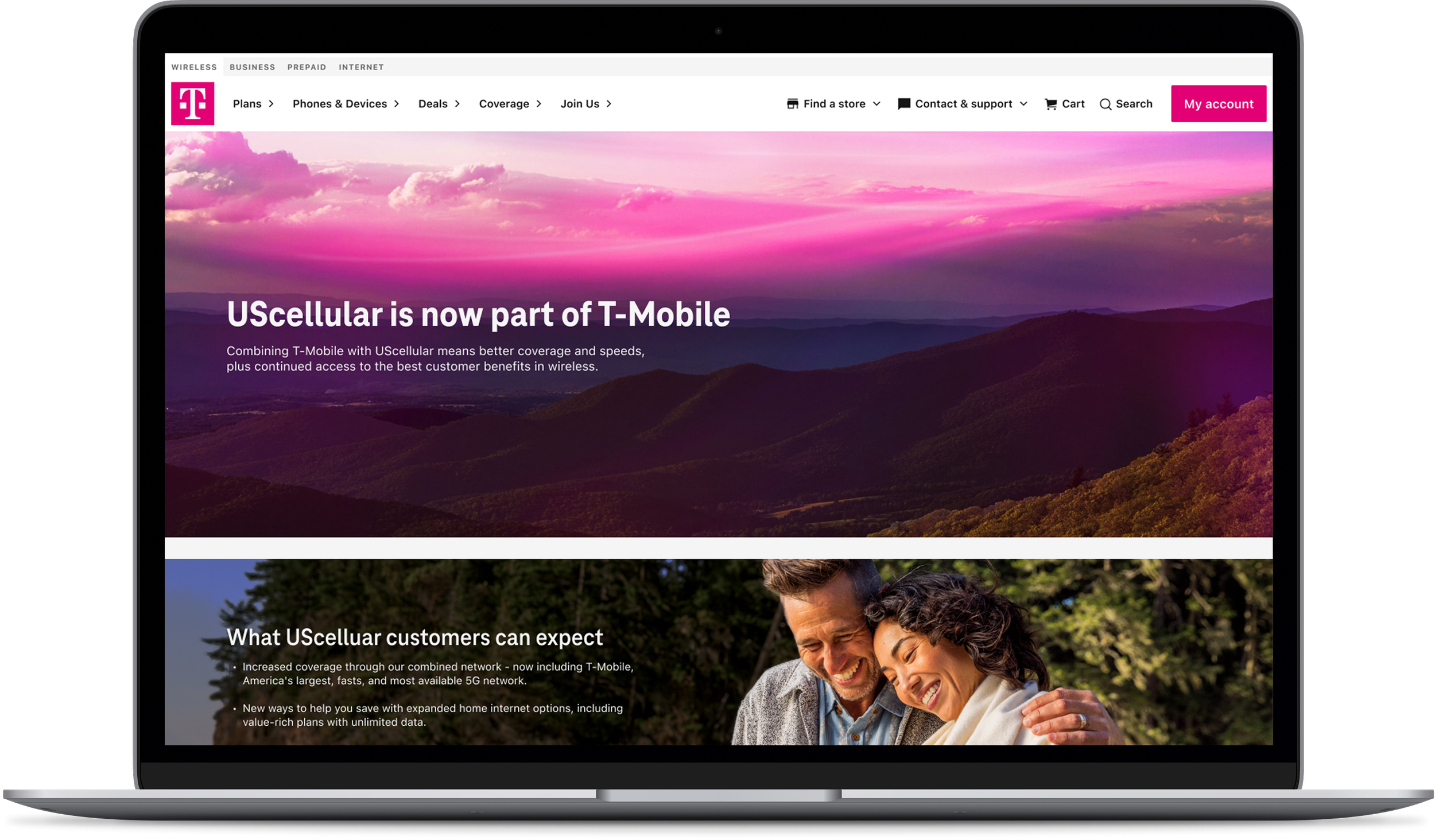
Phase 1 Deal Close acquisition messaging for T-Mobile customers.
Phase 2: T-Launch
Guiding customers through a brand transition with clarity, confidence, and control.
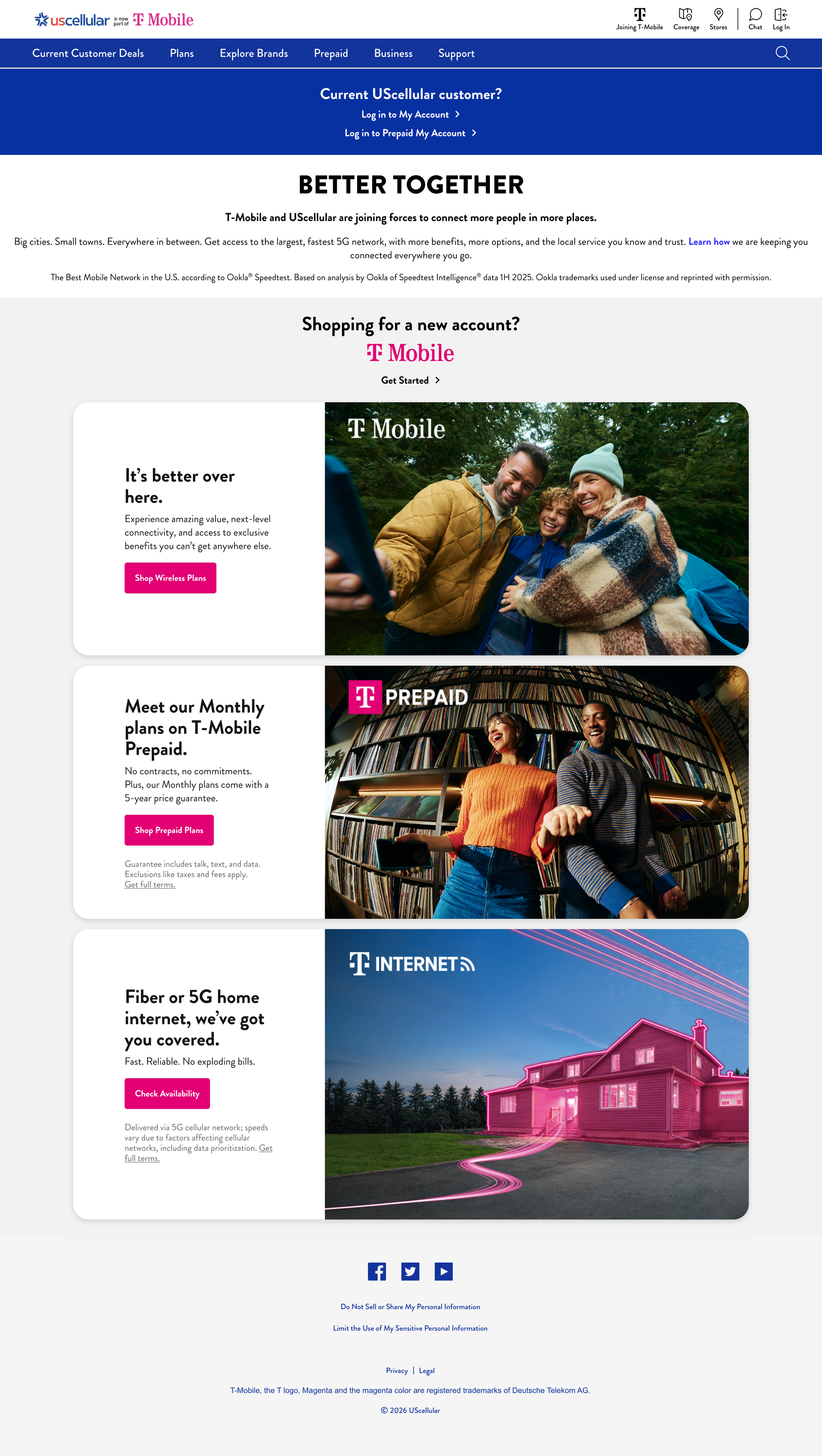
A centralized landing experience that routes prospects and unauthenticated users to the appropriate T-Mobile line of business, while existing USCC customers continue on BAU paths.
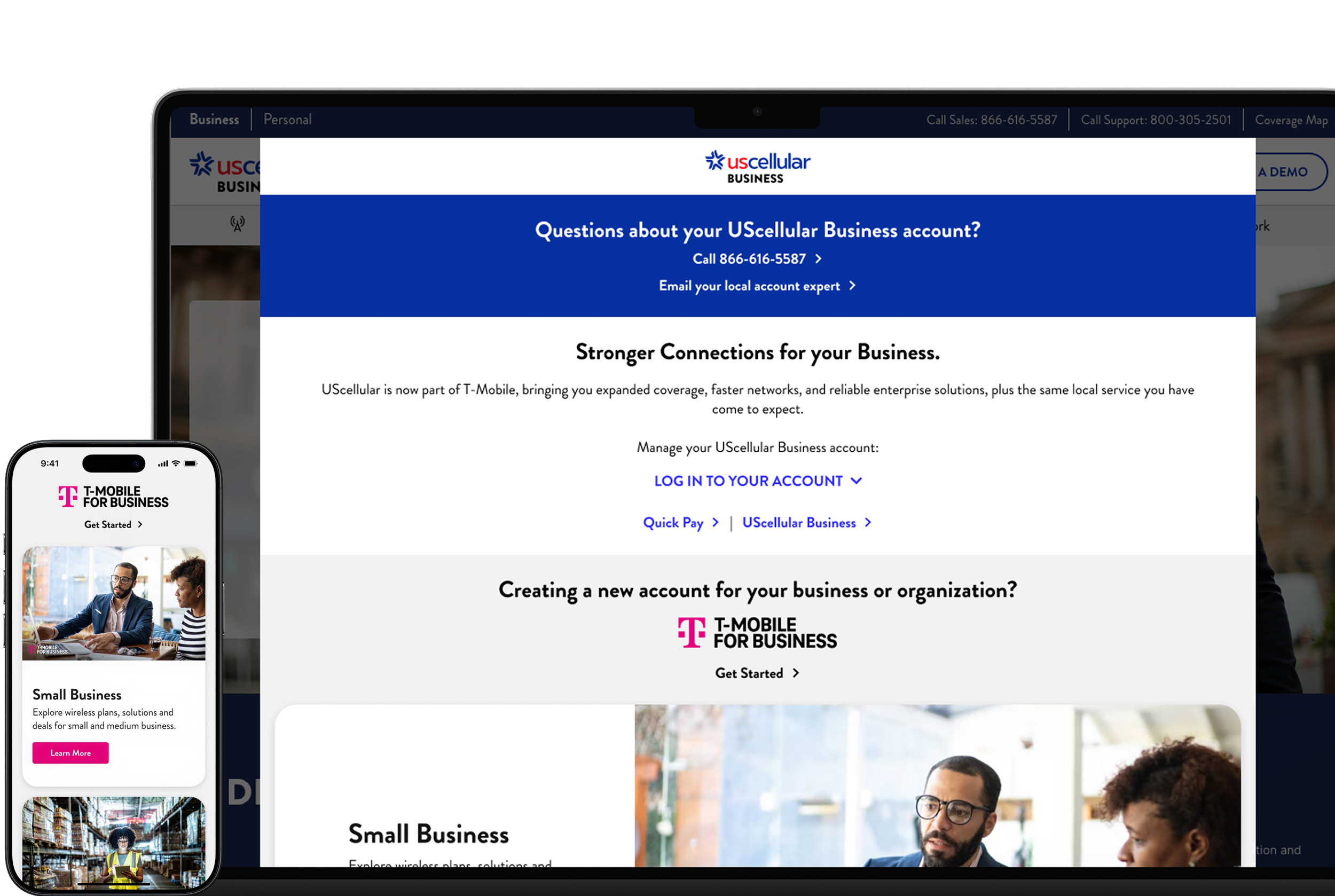
View of the Business Front Door landing page for unauthenticated users and prospects.
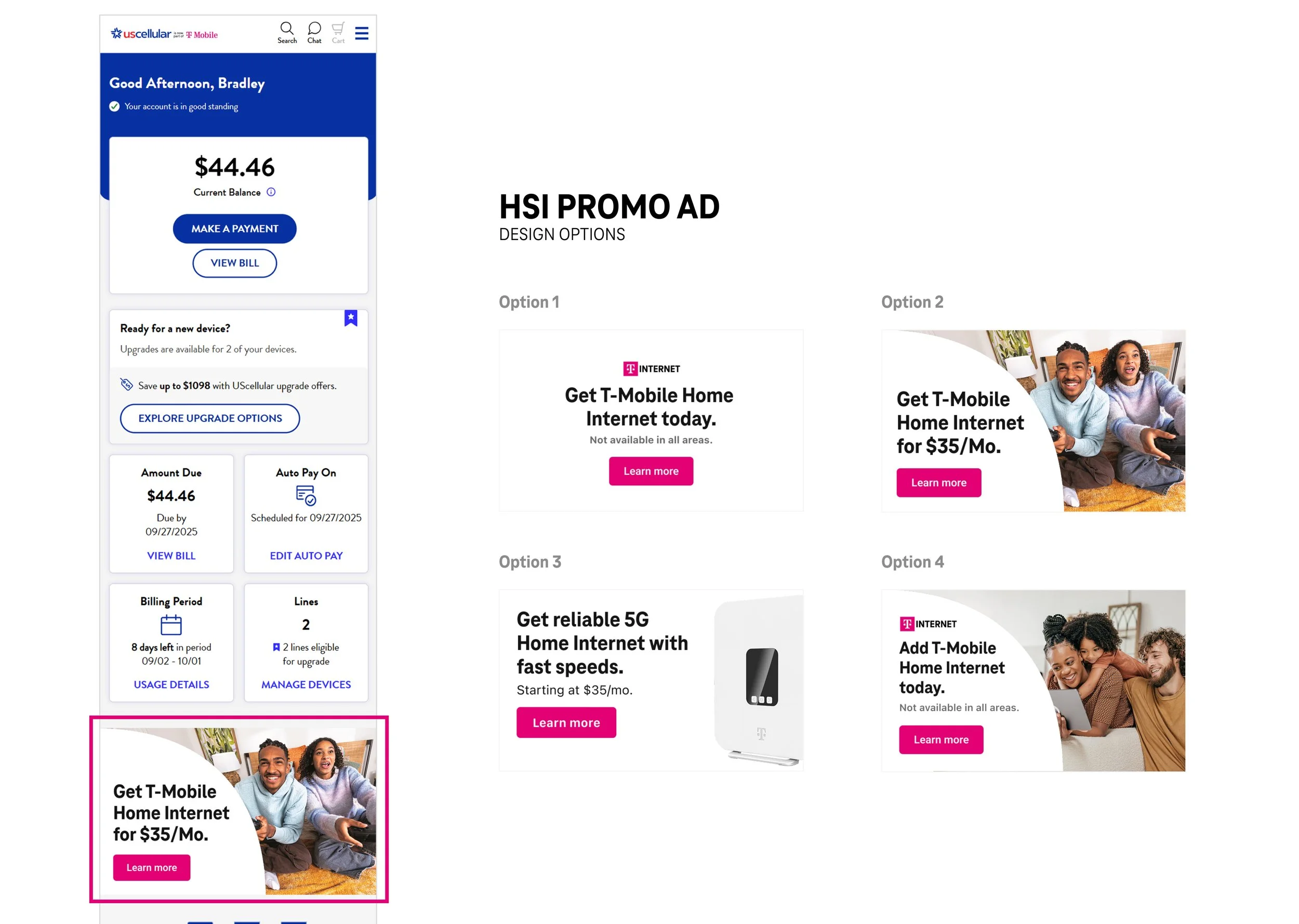
Multiple HSI ad concepts created rapidly using the client’s design system to explore layout and messaging options.
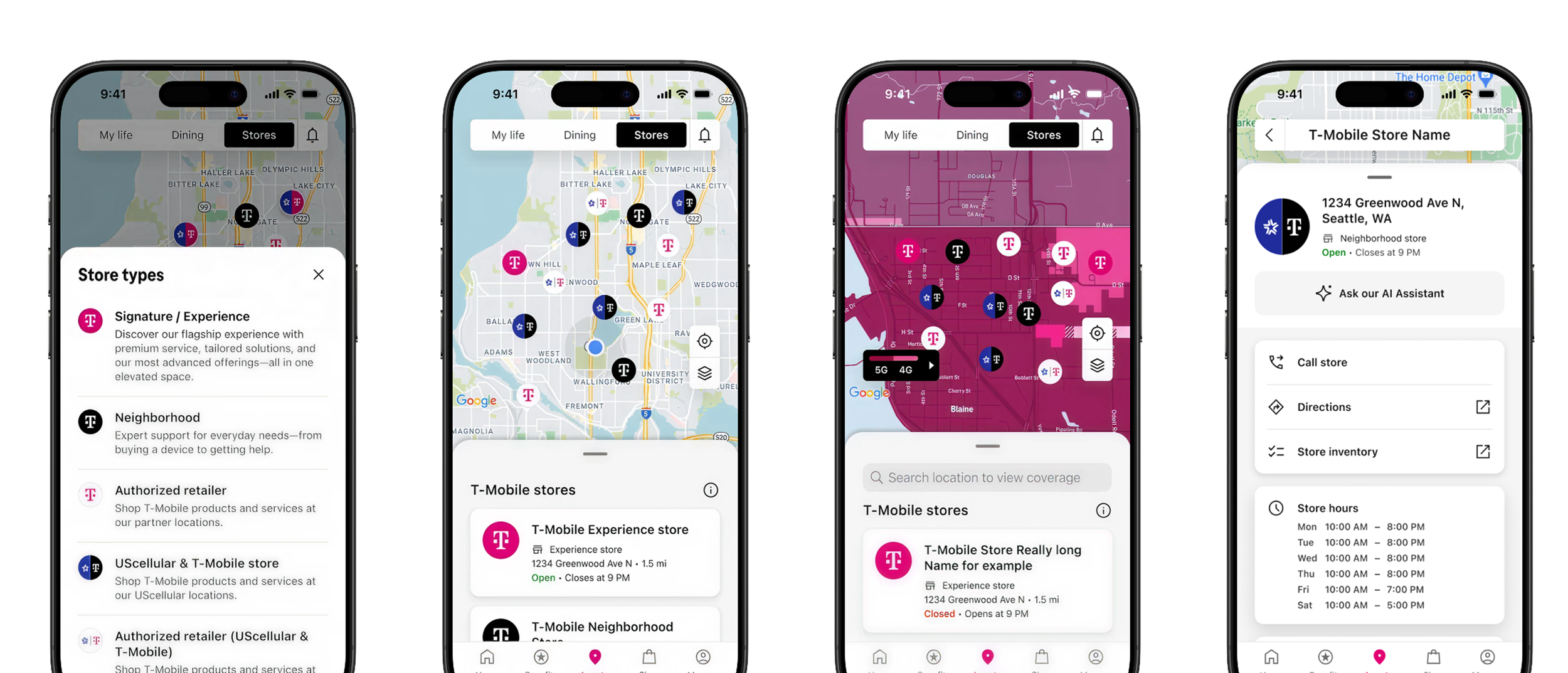
T-Life App: Designed a set of icons and avatars to seamlessly integrate UScellular stores into the T-Mobile store locator experience.
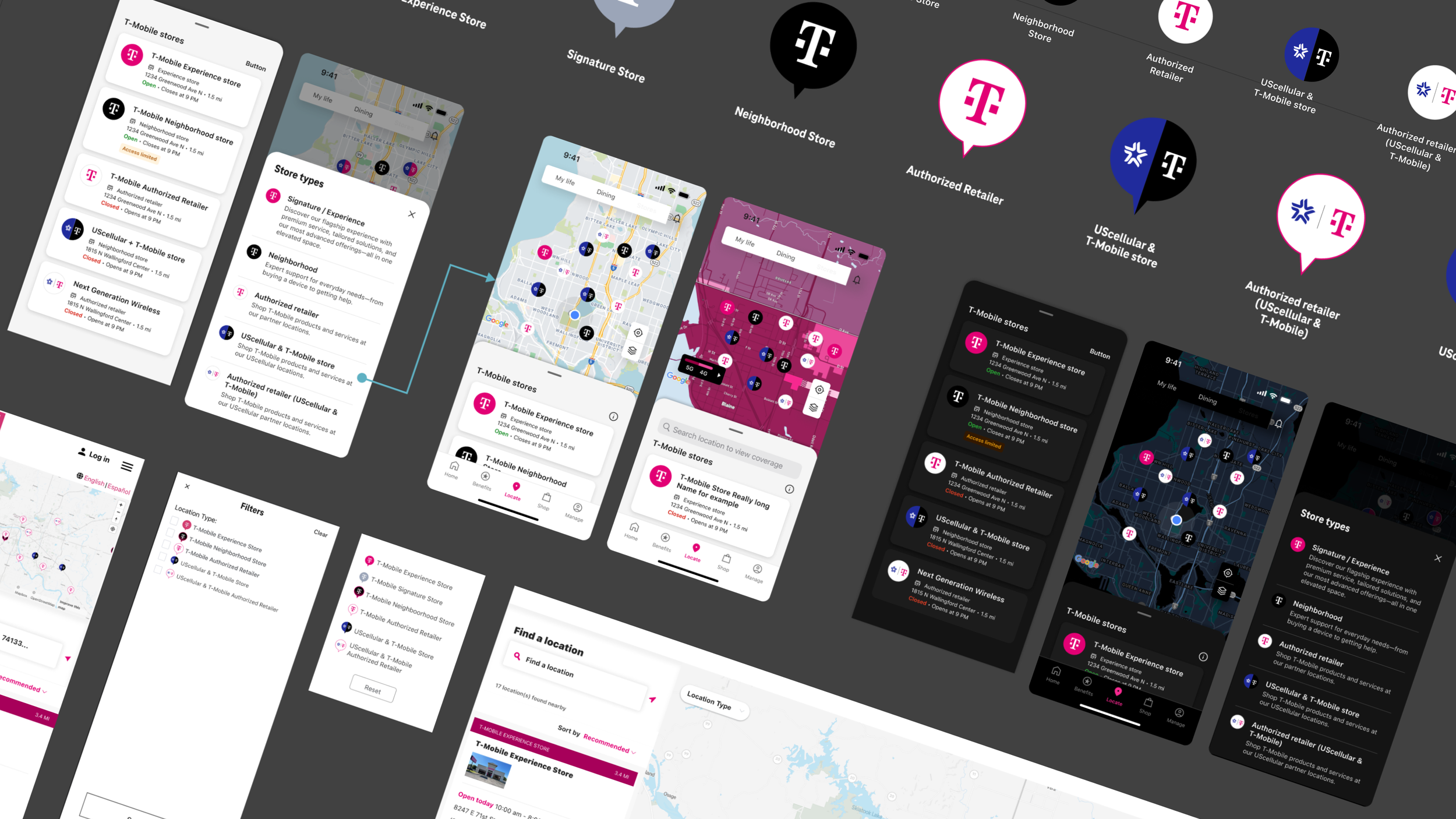
T-Launch store locator designs showing how UScellular physical locations, hybrid stores, and co-branded retail partners were integrated into the T-Mobile locator through new icons, favicons, and visual system updates.
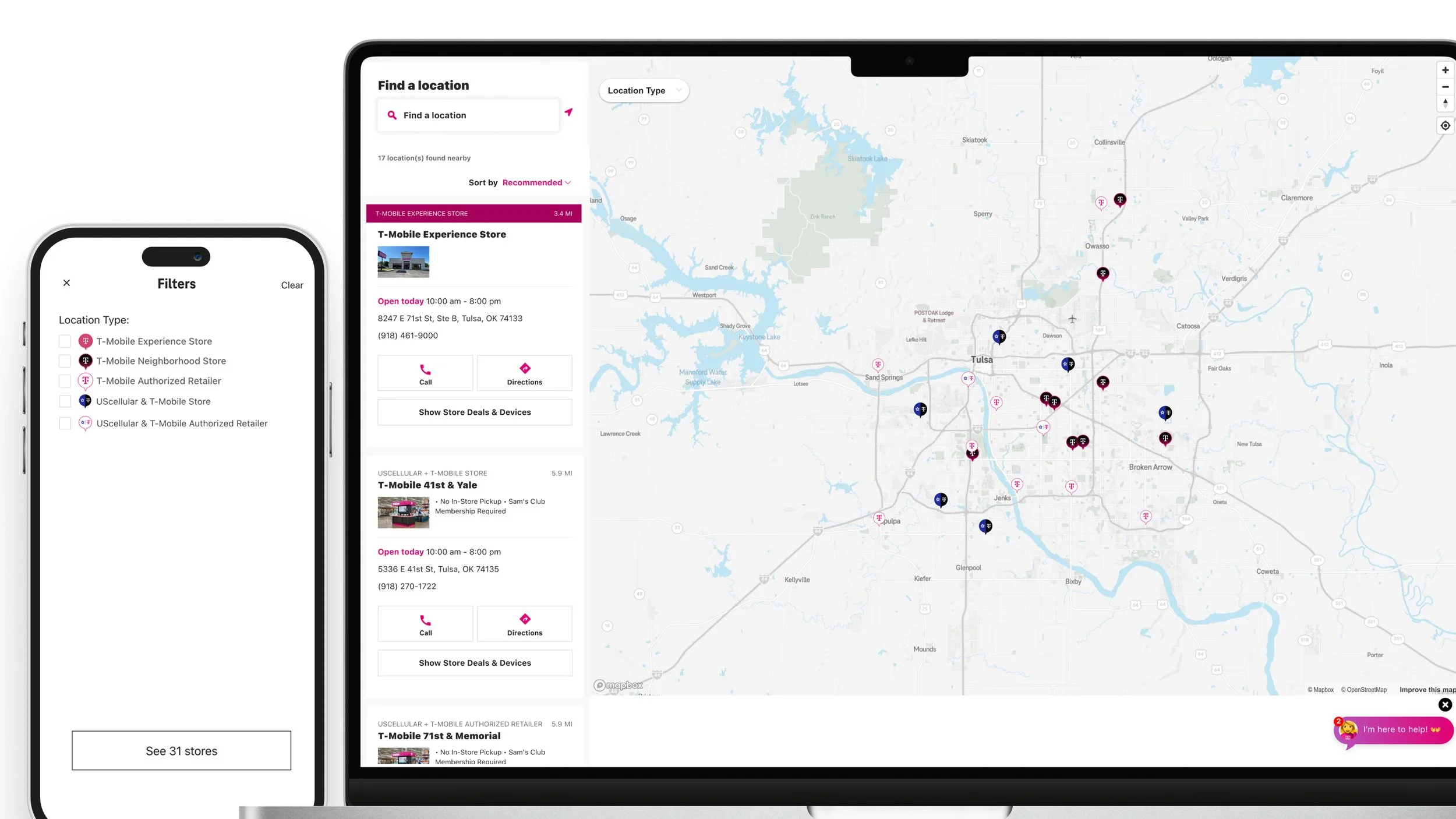
T- Mobile Web: Store locator view showing new dual-branded icons that identify locations supporting both UScellular and T-Mobile services, including corporate and authorized retailers.
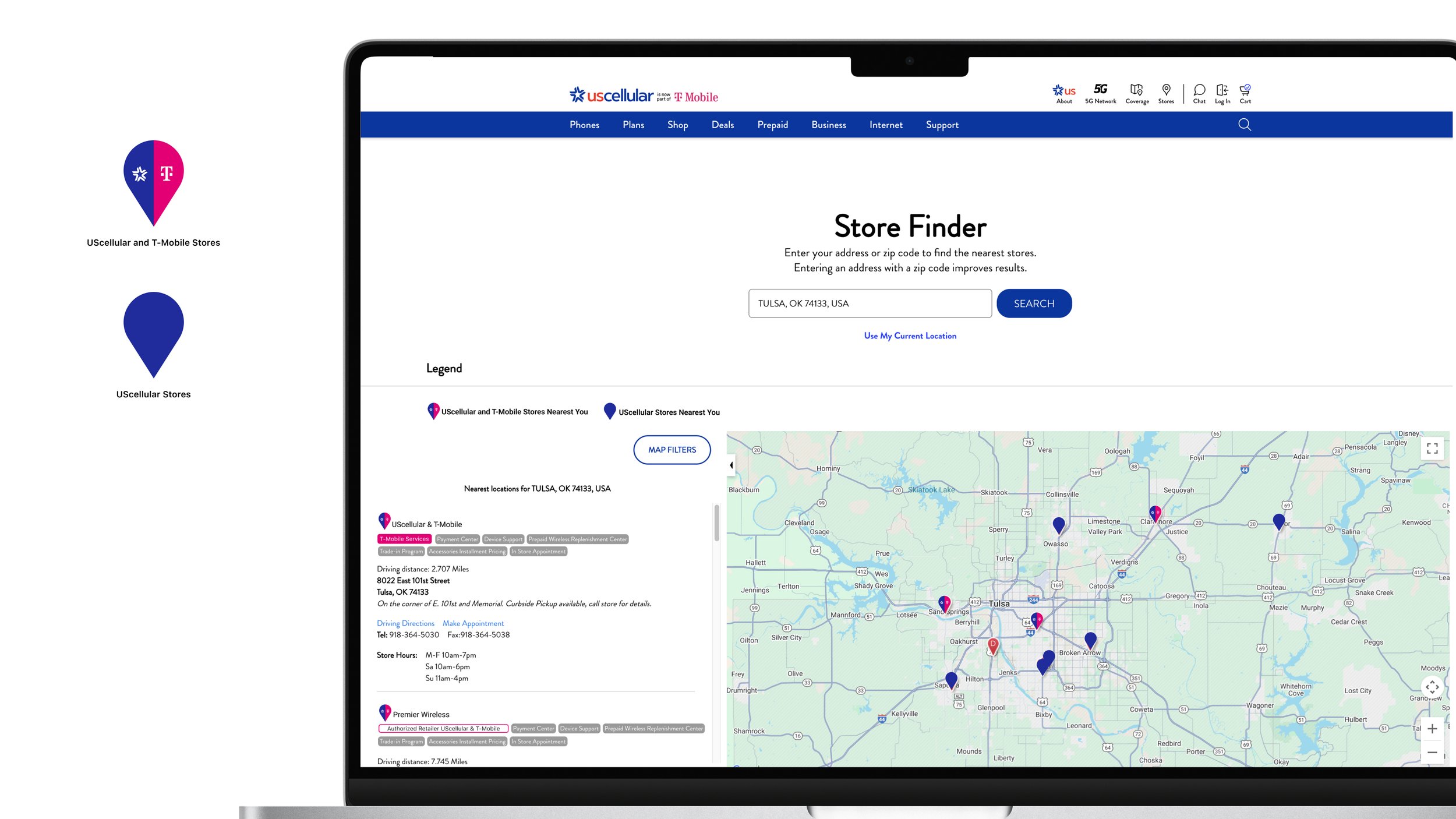
UScellular Web: UScellular store locator featuring newly created dual-branded map icons to distinguish combined UScellular and T-Mobile locations from standalone UScellular stores.
Phase 2 focused on orchestrating the digital transition as integration accelerated.
The goal was to reduce confusion and protect business momentum by routing customers and prospects to the right experience based on intent, account type, and migration readiness.
We designed a unified digital “Front Door,” a shared entry framework that intelligently directed users across consumer, business, prepaid, and internet journeys. Existing UScellular customers were routed to secure, whitelisted sign-in experiences, while prospects were guided to relevant T-Mobile offerings as the brand transition progressed.
Key deliverables included:
End-to-end customer journeys across web and mobile
A unified, intent-based routing system across brands
High-fidelity, production-ready UI built within both UScellular and T-Mobile design systems
Co-branded promotional and transitional entry-point experiences
This phase established clarity, continuity, and scalable migration patterns as customers began engaging more directly with T-Mobile digital products.
Phase 3: Conversion
Seamlessly migrating millions of customer lines to a new platform without disrupting service.
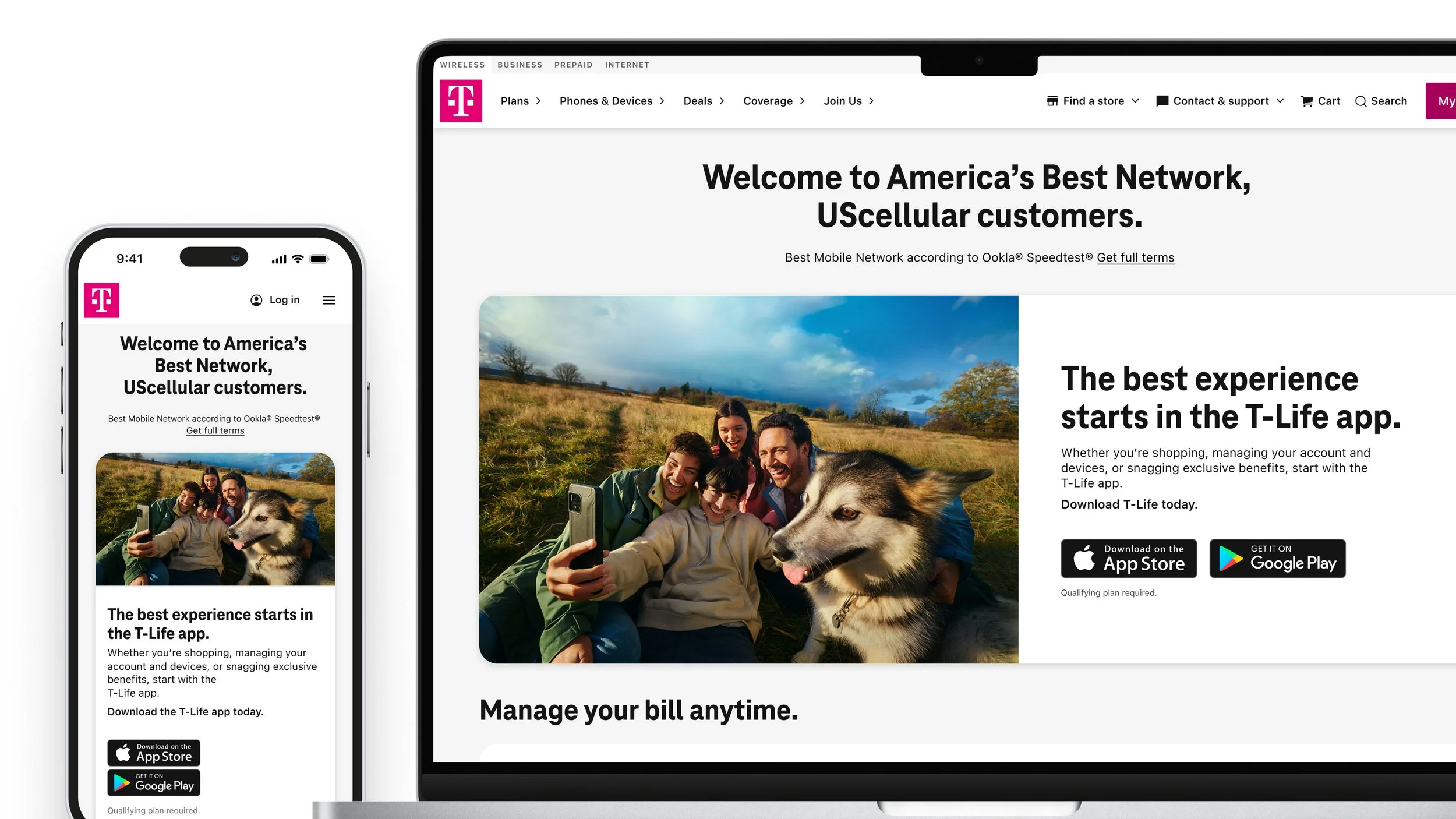
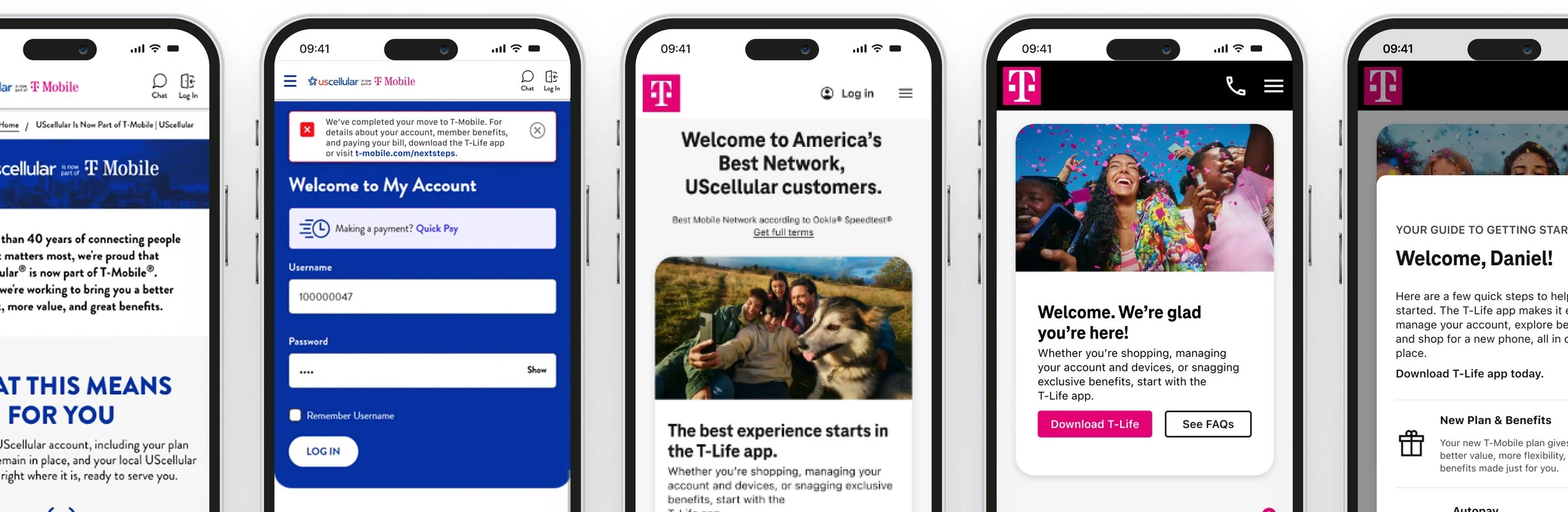
Created a conversion-focused landing page to onboard eligible UScellular customers into the T-Mobile billing and app experience.
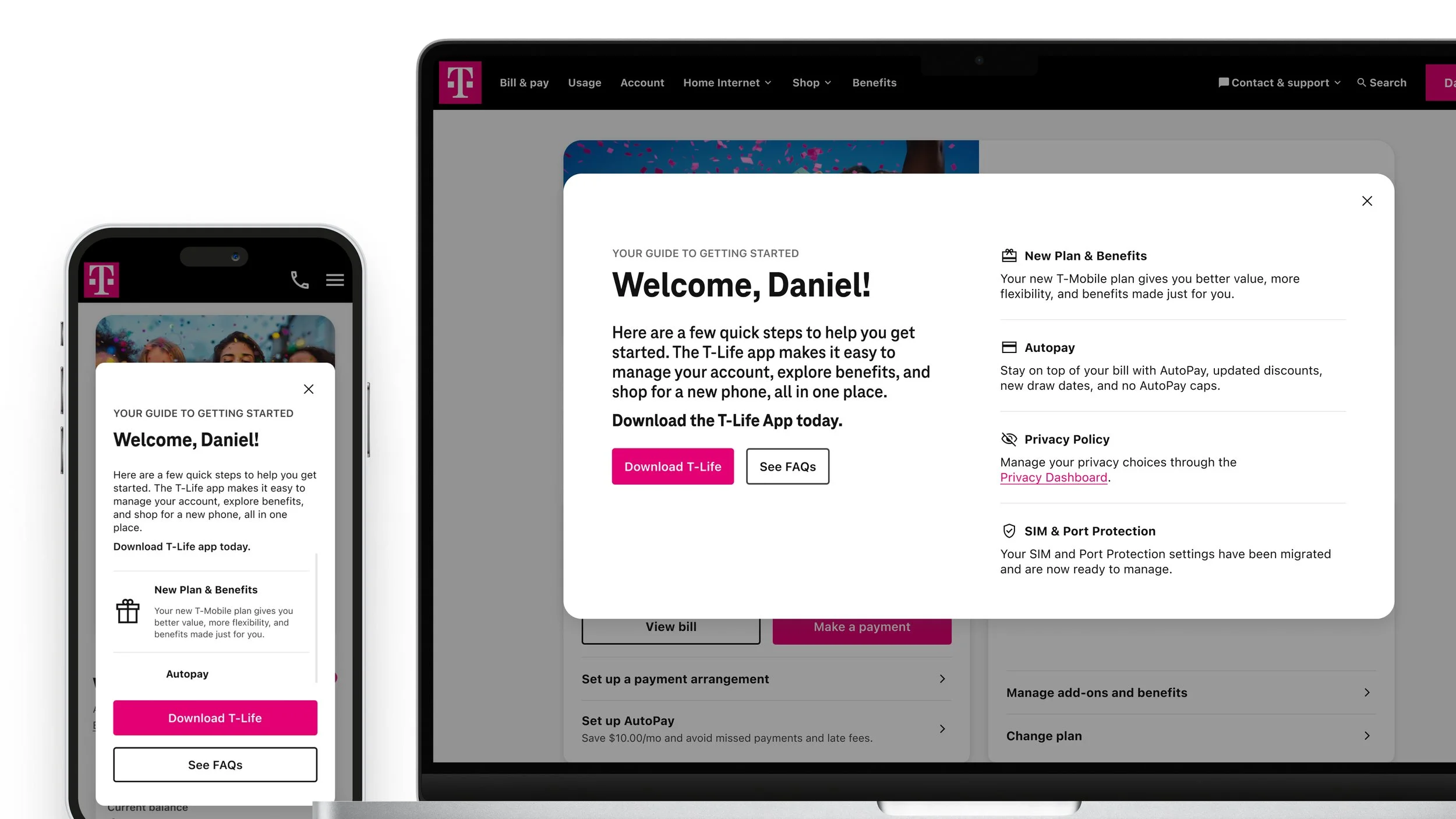
A one-time dashboard welcome guiding customers to T-Life, auto-dismissed after interaction.
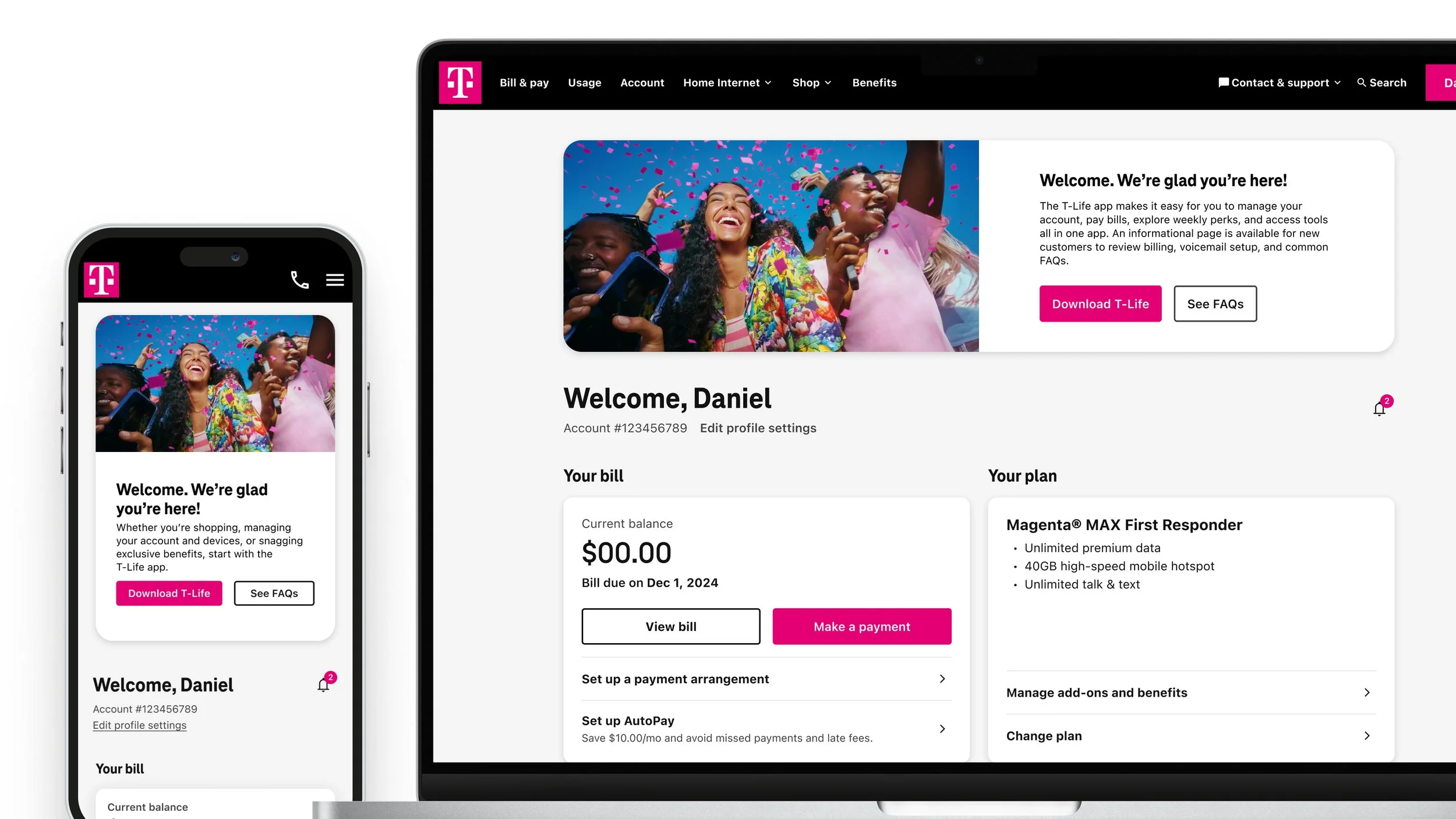
A temporary top-of-page banner promoting T-Life and FAQs, layered onto the existing dashboard experience.
Phase 3 focused on converting eligible UScellular customers into T-Mobile systems at scale while preserving trust and service continuity.
The objective was to establish customers in T-Mobile as if they had always been there, despite fundamental differences in systems, data models, and account structures.
This effort supported the transition of 4M+ lines and the migration of 1.5M+ accounts into T-Mobile’s platform without disrupting service.
Conversion was architected as a clearly defined end-to-end journey moving customers from notification through onboarding. Stages included eligibility preparation, proactive communication, a temporary account lock during system transfer, confirmation of migration, and guided first login into T-Mobile.
Because the transition was mandatory and time-bound, the experience had to reduce uncertainty at every step. Clear contextual messaging, authenticated modals, persistent banners, and a dedicated conversion landing page reinforced transparency while customers moved through locked states and system updates.
Key deliverables included:
A conversion-focused landing page preparing customers for migration
End-to-end conversion flows spanning notification, account lock, confirmation, and onboarding
Defined system states across eligibility, lock, and post-conversion readiness
Authenticated modals and persistent banners providing real-time status
A structured first login experience introducing customers to T-Life and updated web experiences
The conversion landing page served as a critical orientation layer, bridging system transfer with customer reassurance and ensuring a disruption-free transition into T-Mobile.
Phase 4: Conversion Complete
Fully unified T-Mobile systems and brand experience
Magenta Complete marked the culmination of the multi-year integration between UScellular and T-Mobile. At this stage, all remaining UScellular customers were fully migrated onto T-Mobile systems, unlocking the full Un-carrier experience and allowing the formal integration program to wind down.
Customers were fully established within T-Mobile’s billing, network, and digital platforms, with accounts, devices, and contracts managed entirely through T-Mobile. From the customer perspective, the transition was complete.
Key outcomes included:
Full migration of all customers to T-Mobile billing and network systems
Consolidation of UScellular digital platforms into T-Mobile experiences
Transition of stores, employees, and operations to T-Mobile channels
Sunsetting of UScellular brand assets and legacy systems
Magenta Complete represented the final shift from integration to normalization, delivering a single, unified T-Mobile experience and closing the chapter on the UScellular brand.
Impact & Learnings
4M+ Lines. Zero Service Disruption.
This work demonstrates how experience design can function as operational risk mitigation during enterprise transformation. Across a complex, time-bound acquisition, thoughtful UX strategy reduced friction, protected customer trust, and preserved business momentum at scale.
Outcomes
4M+ lines transitioned with no service disruption
1.5M+ accounts successfully migrated into T-Mobile systems
Reduced customer confusion during a mandatory platform migration
Preserved trust and continuity across millions of customer interactions
Established scalable transition patterns for future integration phases
Learnings
Clarity reduces friction during large-scale change
Complex transitions must be broken into visible, manageable states so customers understand what is happening and what to expect next.Consistency builds trust at scale
Even as systems, data models, and brands shifted behind the scenes, the experience remained steady and familiar.Design for uncertainty, not the ideal path
Enterprise migrations require planning for locked states, edge cases, system delays, and imperfect realities.Experience design is change management
During high-stakes transformation, the interface becomes the bridge between operational change and customer trust.